USA Fast Shipping - Love it or Return It
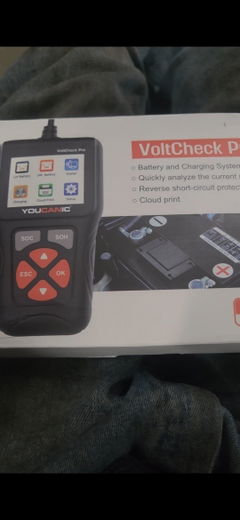
YOUCANIC Scanner – Battery Performance and Overall Review
When I first powered on the scanner, I was concerned about the condition of the battery. The unit arrived showing approximately 80% charge, while the system indicated that the last full charge had occurred about 169 days earlier.
During the initial use, the displayed battery level dropped unusually quickly. For example, during one test it decreased from approximately 72% to 52% in only 28 minutes of operation. Initially, this made it appear that the battery might be defective or had significantly degraded capacity.
Instead of immediately concluding that the battery was bad, I decided to perform several discharge and recharge cycles. During the first cycle, I used the scanner until the battery reached approximately 35% and then fully charged it. During the second cycle, I discharged the battery to approximately 10% and then charged it completely to 100%. That full charging cycle took approximately 4 hours and 14 minutes.
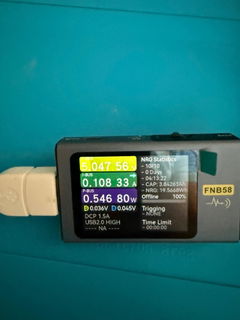
I also monitored the charging process using external USB power meters, measuring the charging voltage and current and observing how the charging current gradually decreased as the battery approached 100%. Based on these measurements, the charging process itself appeared normal.
After these cycles, the battery indication became significantly more stable. During my latest test, I continuously used the scanner for 1 hour and 33 minutes, performing vehicle scans, reading live data, checking OBD-II monitors, and exploring different diagnostic functions. At the end of that session, 71% battery remained. In other words, the scanner consumed 29% of its displayed battery capacity in 93 minutes. If approximately the same discharge rate continues, this corresponds to roughly 5–5.5 hours of continuous operation, which appears reasonable for this device.
Based on my experience, if a newly purchased scanner has been stored for a long period and initially appears to discharge unusually quickly, I would not immediately assume that the battery is defective. In my case, the behavior appears to have been related to an inaccurate State-of-Charge estimate after extended storage rather than clear evidence of actual battery failure. After two discharge/recharge cycles, the battery indication stabilized considerably.
I think this information may also be useful to YOUCANIC and its customers. If a customer reports unusually poor battery performance immediately after receiving a unit that has been stored for an extended period, it may be worth recommending one or two reasonably deep usage cycles followed by a complete recharge before determining that the battery itself is defective. This may allow the battery-management system to establish a more accurate State-of-Charge estimate.
As for the scanner itself, I am currently using it primarily for my own automotive diagnostic work, training, and working on my own vehicle rather than for commercial customer work at this stage.
After spending time with the device and exploring its capabilities, I can say that I am very satisfied with what it offers for the price. At this point, I consider it a very reasonable purchase in terms of the balance between cost and diagnostic capability. It provides full-system diagnostics, Live Data, OBD-II functions, on-board monitors, special functions, active tests, and many other capabilities that I am still learning and exploring.
Based on my experience so far, I believe this scanner is not only a very good tool for personal use and learning, but also appears capable enough for professional automotive diagnostic work. Of course, I will be able to evaluate its long-term professional performance more fully after using it on a wider variety of vehicles, but my experience so far has been very positive.
My next YOUCANIC equipment purchase will most likely be the four-channel automotive oscilloscope. I am going to wait a little longer before purchasing it because I currently use my own two-channel oscilloscope, and for my present diagnostic needs two channels are sufficient. As my automotive diagnostic skills and work develop, however, a four-channel automotive oscilloscope seems like a logical next step.
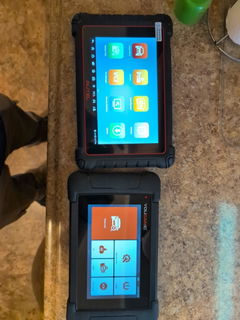
I have also installed a screen protector on the scanner for additional protection. Since diagnostic equipment is regularly handled in an automotive environment and I may eventually use this unit professionally, I think protecting the display is well worth doing.
Overall, after resolving my initial concerns about the battery indication, my experience with the YOUCANIC scanner has been very positive. I am continuing to learn and explore its capabilities, and at this price point I believe it is a very capable diagnostic tool and a very reasonable investment.
I've used several testers over the last 30 years. They have gotten smaller and better! This one is amazing and the price is great! I would definitely recommend it, if you're ir considering a battery tester.
Professional here, I have launch, xtool, and many others. I have used Ford, Honda, Hyundai, Subaru, and other dealer tools. This one is by far my favorite. It's easy to use and affordable. Lifetime support and free updates, with user friendly software is amazing.
So i compared this to my trusted autel mk900bt, and heres an honest review, i paid for the unit myself, and despite having talks with support, and even the company founder himself, i wasnt able to score any freebies haha.
Pros that the youcanic beat the autel-
1. For live data, all the live data values have a recommended parameter value, example: if your one sensor is reading 10mv, and you have no clue what that means, the youcanic will tell you it should be .9-.11 indicating it's all good(i dont know if every bit is 100%, but i assume its all a great guideline)
2. Topology, i spoke to the support team who told me the topology works by actually communicating with the vehicle and plotting out the map of the systems, unlike something like Xtools that just takes a wild guess, although i do think topology is overated, and always has the risk of sending you down a wrong path, it's still good and cool to have over not having it.
3. Free updates, doesn't look like youcanic os going under soon, so that's a huge plus, they seem to care about their product.
4. Autovin scan is not subscription or Internet based, meaning you should be able to connect and automatically scan a vehicle without internet connection, without choosing make, model, submidel/ typing in vin, nice plus if you're mobile and dont have a good hotspot.
5. Scan time of vehicle (detecting vehicle and running diagnostics) takes roughly the same time as autel, 2 minutes. Some cars it was a few seconds faster, some slower.
6. Ive looked into all the scan tools, and this is the best bang for the buck, I'd avoid xtools/ gear wrench, not a fan of topdon, thinkacar, as they are a bit pricey and you should just chose autel, ancel/ foxwell are underwhelming, and autel (mk/ mx 900) is the only other scantool I'd chose for the $500ish range, it is about $50 more than this.
7. Although the autel has some fancy shop management features that kinda beat the youcannic, the youcanic's shop management set up seemed good enough and many times simpler from my quick messing around with, and I feel like it's easier and fine vs the autel.
Now some cons that ive already talked to the company about and they listened to my concerns quite genuinely.
Currently (may be subject to change):
1. The case sucks, the latches are junk and you must use both hands to pry them open when closing the case, and although the scan tool/ dongle wont get banged up, they kinda just sit in their own compartment and wiggle around, feels cheap, and the charger works, but looks sketchy.
2. The hardware is much weaker than the slightly more expensive autel, same storage, but weaker and cheaper quality CPU, smaller/ inferior battery, less/ older gen RAM, worse camera, lower res screen, ect... despite the considerably worse specs, it still seems to perform great when new (minus camera), that being said, i am going to assume after a few years the scan tool may becoming more sluggish, or have hardware issues before the autel, i dont know it that will be 3, 5 or 10 years from now. But it is a factor i considered.
3. While you can find the odemeter reading from each system that stores that data, such as ECU or ABS, you must navigate to diagnostics, run a scan, choose one system, go to live data and scroll through the menu and hope you can find "distance traveled" and read that, and let's say this is some used vehicle you might want to look at a couple other sensors to make sure they all read the same and that nothing was spoofed or replaced, the autel has a "hot function" easy to get to, that reads every system for its distance traveled reading and displays it in a row so you can compare everything to make sure although Domino readings align with each other. Again the youcannic can do the same thing, but the autel is much quicker and better of this is important to you, the team at youcannic said they will look into this.
4. Some active tests seem a bit less refined, and may possibly have you scratching your head, and what I mean by this is certain tests such as sunroof opening and closing with the autel, you tell the autel to open sunroof, and the sunroof opens all the way with one button push, the youcannic on the other hand will only open the center roof about 1 or 2 in per click. So while it can control the module, it sends more of a pulse than a constant signal until the operation completes/ is terminated, I can only imagine there can be certain jobs you're trying to figure out where this will leave you wondering if that is supposed to happen or not, another thing i let support know about.
Tldr. If you're just a diyer who wants something good enough, feature packed for the price, so subscriptions, and is designed for the non-professional while offering near pro level stuff, I'd go with this.
Did everything I needed it to, and I fixed my car and im back on the road. Ty